

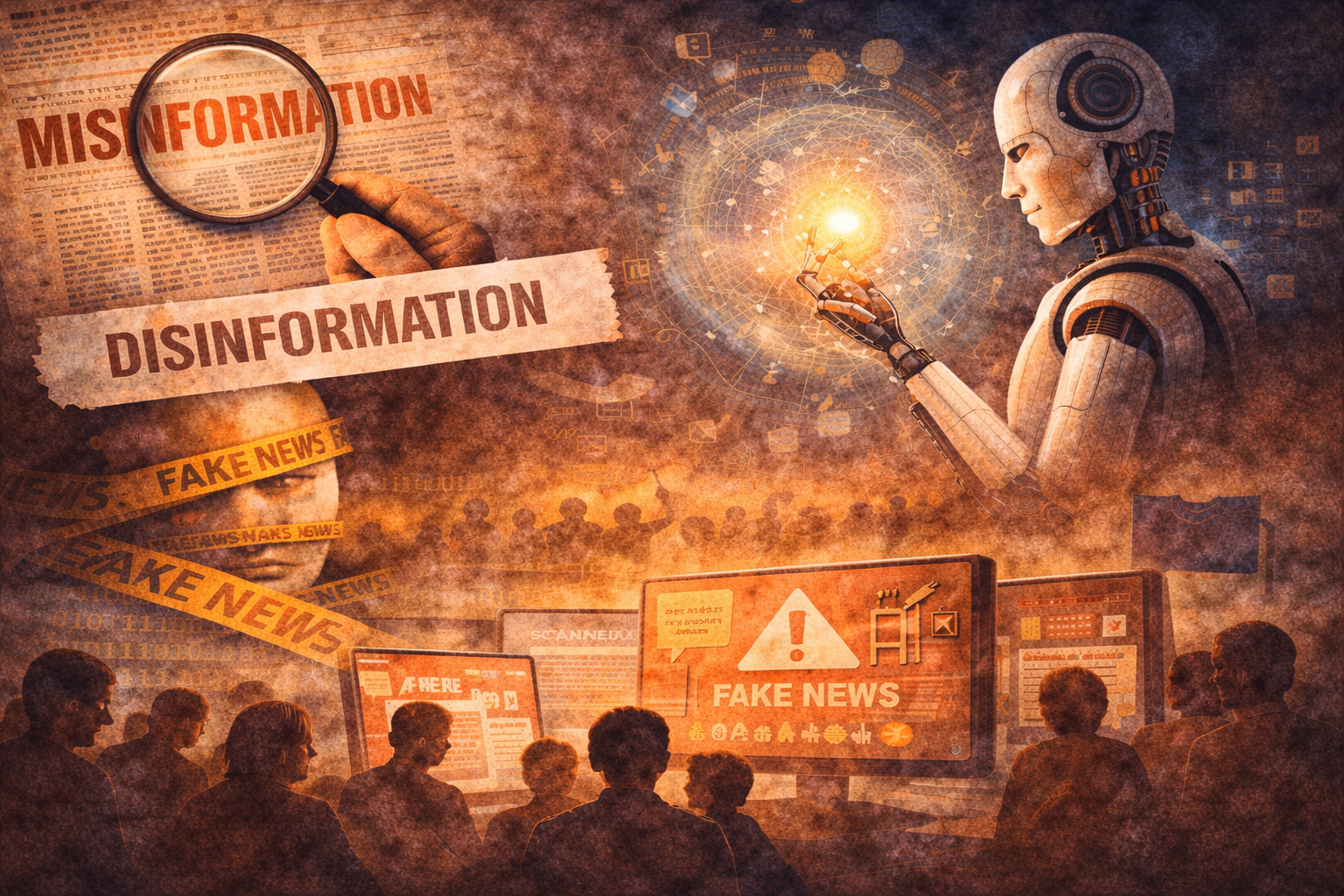
Misinformation and disinformation represent a significant global risk, characterized by the persistent spread of false or manipulated information that undermines trust in facts, institutions, and authority. Misinformation refers to false information shared without harmful intent, while disinformation is deliberately fabricated to deceive or manipulate public opinion. Both phenomena are amplified by the rapid proliferation of digital platforms, social media, and advanced technologies like artificial intelligence (AI), which enable the creation and dissemination of false narratives at an unprecedented scale.
Discussion of the Risk
Current Landscape
Misinformation and disinformation have emerged as critical concerns in the short-term global risk outlook, ranking as the second most severe risk over the next two years in the Global Risks Perception Survey (GRPS) 2025-2026. This risk is particularly acute in regions such as North America, Europe, and Eastern Asia, where it ranks among the top three risks. It is the highest-ranked risk in four economies and features in the top 10 risks in 67 countries.
The integrity of online information is increasingly under threat, with 58% of respondents globally expressing concern about distinguishing truth from falsehood in online news. This figure rises to 73% in Africa and the United States. Trust in news is declining, and news avoidance is rising, further exacerbating the challenge of combating misinformation.
Drivers of Misinformation and Disinformation
- Technological Advancements: The rise of AI tools, including generative AI, has made it easier to create convincing deepfakes and synthetic content. These tools can manipulate video, audio, and text, blurring the line between authentic and fabricated information.
- Social Media Algorithms: Algorithms on social media platforms often amplify content that aligns with users’ existing beliefs, creating echo chambers and reinforcing biases. This selective exposure to information contributes to societal polarization and the spread of false narratives.
- Political and Economic Motives: Disinformation campaigns are often used as tools for political influence, economic gain, or social disruption. Governments, organizations, and individuals may exploit misinformation to achieve strategic objectives.
Impacts
- Erosion of Trust: Misinformation and disinformation undermine trust in institutions, media, and governance structures. This can lead to a fragmented public sphere where consensus on basic facts breaks down.
- Societal Polarization: The spread of false information deepens ideological and cultural divisions within communities, contributing to social instability and political gridlock.
- Economic Disruption: Misinformation can influence consumer behavior, disrupt markets, and damage corporate reputations, leading to financial losses.
- Threats to Democracy: In democratic systems, misinformation can distort public discourse, influence elections, and weaken democratic processes. In autocratic regimes, it can fuel fear and conspiracy theories, potentially inciting violence.
Future Outlook
Over the next decade, misinformation and disinformation are expected to become even more pervasive, driven by advancements in AI and the increasing reliance on digital platforms for information. The GRPS findings indicate that misinformation and disinformation will remain a top concern, ranking fourth in severity over the 10-year horizon. The risk is closely interconnected with other global challenges, including societal polarization, inequality, and cyber insecurity.
Actions for Mitigation
- Public Awareness and Education: Digital literacy initiatives are critical to empower individuals to recognize and address biased or harmful content. Governments, civil society, and private-sector organizations must collaborate to ensure these campaigns are accessible to diverse communities.
- Content Authenticity Standards: Developing and adopting technical solutions such as digital watermarking, blockchain-based rights management, and content origin tracking can help ensure the authenticity of information.
- Regulatory Frameworks: Policymakers should establish regulations to address the creation and dissemination of false information, while balancing the need to protect freedom of speech and expression.
- Multi-Stakeholder Engagement: Platforms for exchanging knowledge, best practices, and alignment among governments, businesses, and civil society can enhance collective efforts to combat misinformation and disinformation.
Conclusion
Misinformation and disinformation are not only technological risks but also societal and geopolitical challenges with far-reaching consequences. As these risks continue to grow in scale and complexity, addressing them requires coordinated global action, robust governance frameworks, and widespread public education. By fostering trust, promoting transparency, and leveraging technology responsibly, the global community can mitigate the impacts of misinformation and disinformation and safeguard the integrity of information ecosystems.
A Biblical Perspective – Misinformation and Disinformation
Zechariah 8:16 (ASV) – These are the things that ye shall do: Speak ye every man the truth with his neighbor; execute the judgment of truth and peace in your gates;
This verse echoes the call for truthful speech as a foundational social ethic. Linking truth with justice and peace, it reinforces that honesty is not merely a private virtue but a public duty that shapes communal life. In a context of misinformation, it underscores that truthful communication and fair judgment are essential for societal stability and genuine peace.
Psalm 15:1-2 (ASV) – Jehovah, who shall sojourn in thy tabernacle? Who shall dwell in thy holy hill? He that walketh uprightly, and worketh righteousness, And speaketh truth in his heart;
Here, truth is presented as an internal disposition, not just external accuracy. To “speak truth in his heart” means to be consistently sincere and aligned with God’s standards, even when no one is watching. This internal integrity is the foundation for trustworthy relationships and resilient communities in an age where hidden motives and half-truths often erode confidence.
Proverbs 14:5 (ASV) – A faithful witness will not lie; But a false witness uttereth lies.
This proverb draws a sharp contrast between the faithful and the false witness, highlighting the moral weight of what we say. Faithfulness is defined by a refusal to lie, especially when our words shape others’ perceptions of reality. In a culture where narratives can be manipulated, this verse calls believers to be reliable sources of truth who resist any temptation to distort facts.
1 Peter 3:10 (ASV) – For he that would love life, And see good days, Let him refrain his tongue from evil, And his lips that they speak no guile:
Peter connects a good, flourishing life with disciplined speech free from deceit. “No guile” points to speech without manipulation, spin, or hidden agendas. This challenges us to evaluate not only what we say but how and why we say it, recognizing that personal well-being and communal trust are deeply affected by the integrity of our words.
3 John 1:4 (ASV) – Greater joy have I none than this, to hear of my children walking in the truth.
John reveals the deep joy that comes from seeing others live in consistent, practical alignment with truth. “Walking in the truth” goes beyond believing correct doctrines; it involves a lifestyle of honesty, transparency, and faithfulness. In a world saturated with deceptive influences, this verse highlights the spiritual beauty and significance of lives firmly grounded in truth.
Related Bible Devotional Chapters
Misinformation in the Public Square
In an age when misinformation spreads faster than ever, Christians are called to stand firmly in God’s unchanging truth and resist the deceptive voices that distort reality for gain, confusion, or control. Rooted in the character of “a God of truth and without iniquity” (Deuteronomy 32:4), Scripture presents truth not as an optional virtue but as a moral and spiritual mandate that shapes how we think, speak, and interact with the world. The digital landscape, through social media, partisan outlets, and AI-generated content, has only intensified the challenge of discerning fact from falsehood, making it easier for even well-intentioned believers to be misled or to unwittingly spread error.
This chapter draws on the wisdom of Proverbs, Paul’s letters, and other biblical passages to equip followers of Christ with integrity, discernment, and careful speech, so that we might love the truth, test what we hear, seek wise counsel, and avoid contributing to the communal harm caused by lies. As we listen to God’s Word and apply its guidance to our complex information environment, we can honor Christ, protect our neighbors, and strengthen the church’s witness in a world desperately in need of trustworthy voices.
Deepfakes and the Value of Truth
In an era where technology can so easily distort reality, the rise of deepfakes confronts believers with urgent questions about truth, deception, and integrity. As false images, videos, and audio become increasingly convincing, the biblical call to walk in truth takes on new relevance and weight.
This study invites Bible students to examine how Scripture speaks into a culture of digital manipulation and misinformation, and how God’s unchanging standard of truth can anchor us when appearances can no longer be trusted. By grounding ourselves in God’s Word, we can learn to discern truth from error, guard our hearts and minds, and embody honesty and integrity in a world where seeing is not always believing.
AI Power and Human Wisdom
In an era dominated by algorithms and artificial intelligence, this chapter invites readers to reflect on the crucial difference between technical knowledge and true wisdom. While machines can process data, automate decisions, and simulate human conversation, Scripture points us to a deeper, enduring wisdom found in the fear of the Lord and a life aligned with Christ.
The selected passages that follow draw a clear contrast between the impressive capabilities of AI and the spiritual discernment that only God provides, urging believers to seek His guidance above all, to remain cautious before the promises of new technologies, and to anchor their trust not in human innovation, but in the unchanging wisdom and character of God.
Polarization and the Mild Answer
In an era when social, political, and religious conflicts seem to intensify by the day, followers of Christ are called to respond in a way that is strikingly different from the surrounding culture. Rather than mirroring the outrage, hostility, and divisive rhetoric that dominate public discourse, Scripture invites believers into a posture of humility, gentleness, and intentional peacemaking.
This chapter introduces key biblical principles that equip Christians to engage conflict without compromise, to answer harshness with grace, and to pursue reconciliation even when it is costly. By examining how the Bible addresses anger, listening, and the active work of making peace, we will see that God’s people are not passive observers in a polarized world but are instead called to be courageous ambassadors of Christlike peace.
Leave a Reply